
How Tanks Are Made
What Is a Blow-Moulded Water Tank?
Blow moulding forms a tank body from one continuous piece of plastic, with its layers laid down in the same shot and an inner surface shaped by air. What that means in practice, and how it differs from rotational moulding.
4 min readUpdated
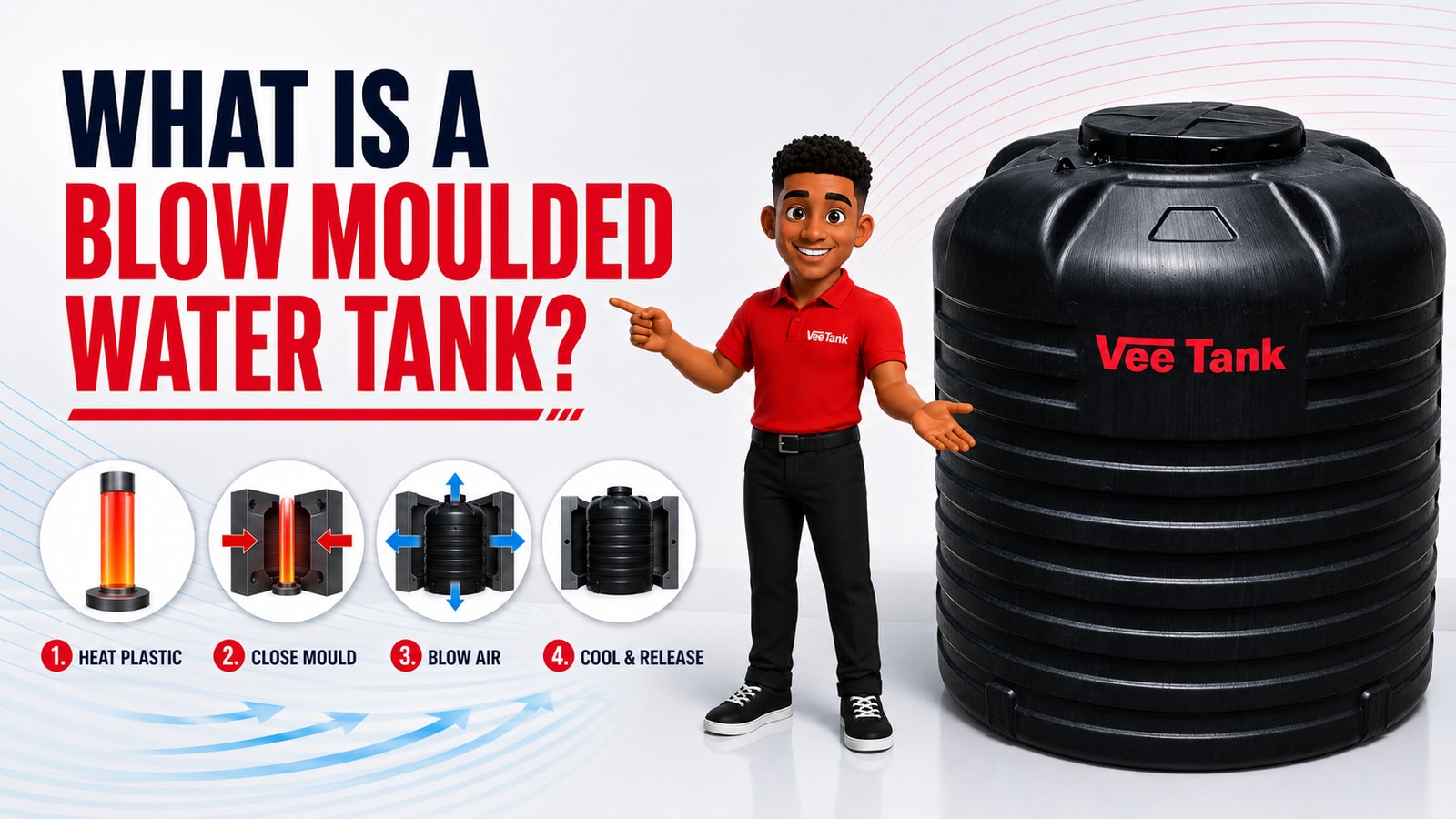
In short: blow moulding forms the tank body in a single operation — a tube of molten plastic is inflated against the inside of a mould until it takes the shape. There is no seam, the layers are laid down together in the same shot, and the inner surface is shaped by air rather than pressed against a mould face.
Most water tanks sold in Kenya are rotationally moulded. Vee Tanks are blow moulded, which is a well-established process — decades old — but a newer choice for domestic water tanks in this market. Here is what it actually involves.
How blow moulding works
Four stages, and it happens in one cycle:
- Extrude. Molten polyethylene is pushed out as a hollow tube — the parison. Where a tank has several layers, they are extruded together, one inside the next, at this moment.
- Clamp. The mould closes around the tube.
- Inflate. Air is blown into it. The tube expands until it presses against the mould wall and takes its shape.
- Cool and release. The plastic cools against the mould and the finished body comes out.
The body has no join because it was never in pieces.
What follows from it
Three things follow from the process directly:
One piece, no seams. The body is formed in a single operation, so there is no join to work loose over time.
The layers are formed together. In a three-layer tank the layers are laid down in the same shot rather than added one after another. That means the inner food-grade layer is not a liner fitted afterwards — there is nothing to lift or separate from the wall behind it, because it was never a separate part.
A smooth inside. The inner surface is shaped by air pressing outward, not by contact with a mould face. It comes out smooth, which means less for sediment and biofilm to hold on to and an easier tank to rinse down when you clean it.
How rotational moulding differs
Rotational moulding — roto moulding — is the other common process, and it is worth understanding rather than dismissing.
Polyethylene powder is loaded into a mould, the mould goes into an oven, and it is rotated on two axes while the powder melts and coats the inside. The plastic builds up against the mould face as it turns.
The differences that matter:
| Blow moulding | Rotational moulding | |
|---|---|---|
| Wall formed by | Air pressure outward | Powder settling against the mould |
| Inner surface shaped by | Air | The plastic's own free surface |
| Layers | Extruded together in one shot | Added in successive charges |
| Cycle | Faster, one operation | Slower, oven-based |
Both processes make good tanks and both make bad ones. The process sets what is possible; the manufacturer decides what is delivered. A well-made roto-moulded tank will comfortably outlast a badly made blow-moulded one, and the reverse is just as true. Anyone who tells you the process alone settles the question is selling you something.
What the process does tell you is how the tank in front of you came to be the shape it is — and for a layered tank, whether the inner surface is part of the wall or something added to it.
Why we say "newer here"
Blow moulding is not a new technology. It has been used for decades for containers of every kind, from bottles to fuel tanks.
What is newer is applying it to domestic water storage tanks in this market, where rotational moulding has long been the norm. That is a genuine difference worth knowing about — and it is a different claim from saying the tanks are therefore better than everyone else's, which is not something a manufacturing process can prove on its own.
What to actually check
Whichever process made it, the tank should have:
- A food-grade inner surface, ideally virgin material
- A wall that blocks light, so algae has nothing to work with
- UV stabilisation on the outer layer
- Even wall thickness all the way round
- A warranty long enough that the manufacturer is carrying real risk
Those are covered in more detail in what makes a quality water tank.
The Vee Tank wall
Three layers, formed together in one shot:
- Premium outer layer, black, for UV protection
- Middle layer, grey, for added strength and opaqueness
- Inner layer, white virgin material, food grade and anti-algae
Six sizes from 1,000 to 10,000 litres, made in Kenya by Astral Industries Limited, with a 12-year warranty.