
Buying Guide
What Is the Best Quality Water Tank to Buy?
Eight marks of a quality water tank — food-grade material, layered construction, UV stabilisation, an opaque wall, even wall thickness, a real warranty, local support and seamless construction — and how to check each one before you buy.
5 min readUpdated
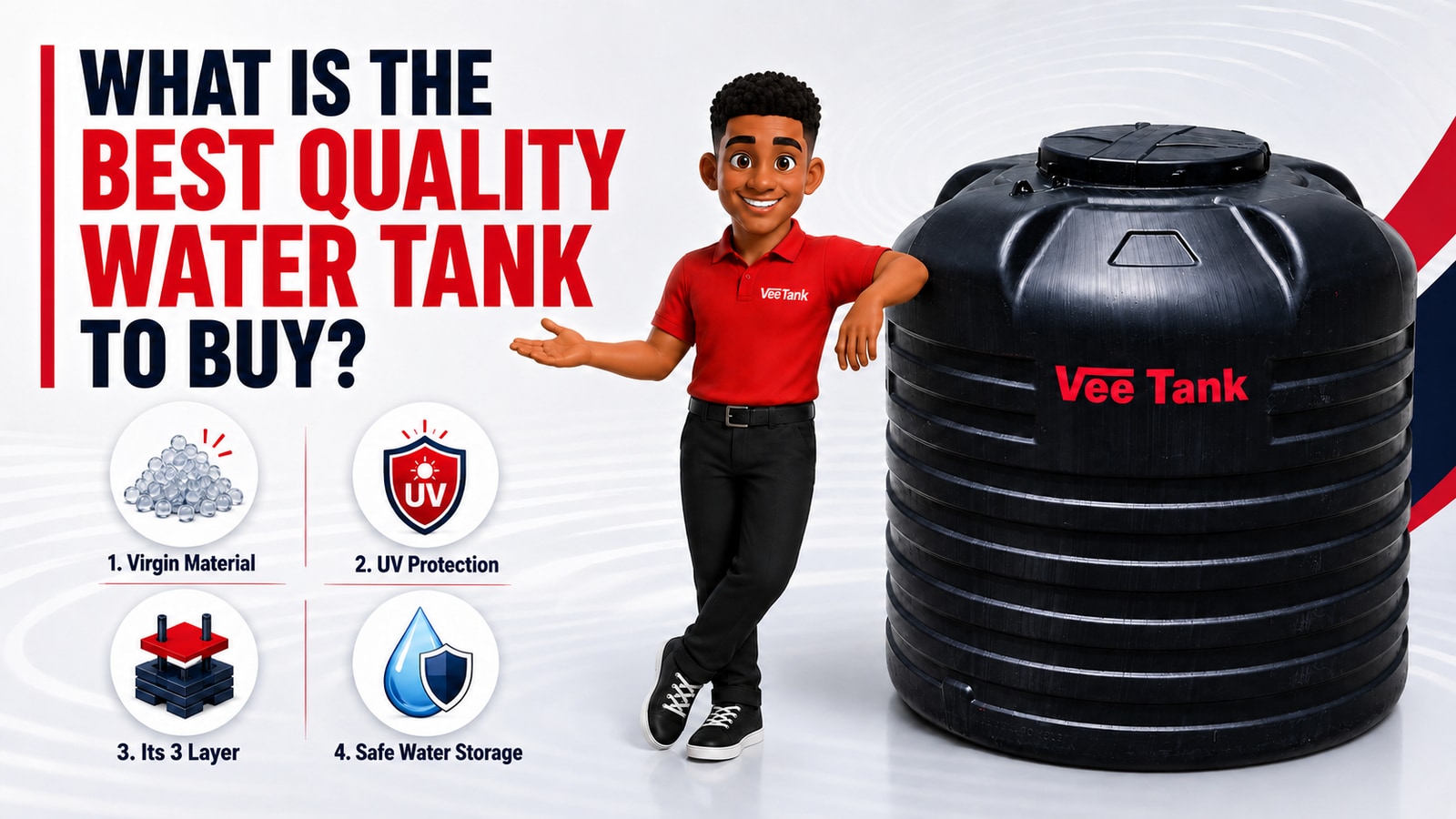
In short: the best tank is the one whose inner surface is food grade, whose wall keeps sunlight out, whose thickness is even all the way round, and whose warranty is long enough that the manufacturer is taking a real risk. Everything else is secondary to those four.
That sounds obvious. It matters because none of it shows on delivery day. A good tank and a cheap one look much the same standing in the yard. The difference appears in year three, in the sun.
The eight things worth checking
1. A food-grade inner surface
The layer your water touches should be food-grade polyethylene — material approved for contact with drinking water, non-toxic, and not going to leach into what it holds.
The distinction that matters in practice is virgin material versus regrind. Virgin polyethylene is new, of known composition. Regrind is reprocessed plastic: cheaper, and nobody can tell you with certainty what it was before. For the one surface that touches drinking water, that uncertainty is the entire problem.
Vee Tank's inner layer is white virgin food-grade material.
2. Layers, and what each one is for
A single-layer tank asks one material to do three jobs at once: survive the sun outside, carry the load, and be safe against water inside. No single formulation is best at all three.
A layered wall gives each job its own layer. In a Vee Tank:
- Outer, black — takes the sun, the rain and the knocks
- Middle, grey — adds strength, and blocks light
- Inner, white — virgin food-grade material, the only surface the water meets
What matters is that the layers are formed together rather than lined afterwards. A liner added as a second operation is a liner that can lift, wrinkle or separate. Vee Tank's three layers are laid down in the same moulding shot.
3. UV stabilisation
Kenyan sun is not gentle. Unprotected polyethylene chalks, then goes brittle, then cracks — usually along the top curve, where the sun sits longest.
UV stabilisation is an additive, not a coating, so you cannot see it. What you can do is ask whether the outer layer is UV stabilised and get a straight answer, and look at how the manufacturer's older tanks in the field have aged.
4. An opaque wall
Algae needs three things: warmth, nutrients and light. You cannot do much about the first two in a tank standing in Kenya. You can take away the light.
A wall that lets light through will grow algae no matter how often it is cleaned. A wall that does not, will not. This is the single most under-rated thing on the list, and it is why a translucent tank is a false economy however cheap it is.
Hold a torch against the outside of any tank you are considering, in shade. If you can see the glow from inside, keep looking.
5. Even wall thickness
A tank fails at its thinnest point, and the thin point is usually somewhere you cannot see. Uneven walls are the commonest defect in cheap tanks, and the reason two tanks of the same nominal capacity and material can behave completely differently in year five.
Weight is a rough proxy: for the same capacity and design, a heavier tank has more material in the wall. Run a hand over the surface for dents, thin patches and irregular ribbing.
6. A warranty that costs the manufacturer something
A warranty is not a promise about quality; it is a bet on it. The length tells you how long the manufacturer is willing to carry the risk of their own product failing.
Every Vee Tank carries a 12-year warranty from Astral Industries Limited. Ask any manufacturer for the terms in writing before you buy — what it covers, what voids it, and what you actually do to claim.
7. Local manufacture and local support
A warranty is only worth the ease of claiming it. A tank made in Kenya by a company with a local factory means spares, support and the warranty are all reachable, and a claim is a phone call rather than a shipping problem.
Vee Tanks are made in Kenya by Astral Industries Limited.
8. Seamless construction
A join is a weak point and a place for residue to sit. A body formed in one piece has neither.
Vee Tanks are blow moulded: the body is formed in a single operation, so there is no seam to work loose, the three layers are laid down together, and the inner surface is shaped by air — which leaves it smooth, with less for residue to hold on to.
What does not matter as much as you think
Colour. Black outside is about blocking light and handling UV, not about looks. A tank that is black for the right reason is doing its job.
Ribbing and styling. Ribs add stiffness, which is real. Beyond that, the moulded detailing on the side of a tank is styling.
Price alone. The cheapest tank on the yard is cheap for a reason, and it is usually one of the eight above. Work out the cost per year of service rather than the cost on the day: a tank at a third more that lasts twice as long is the cheaper tank.
A short checklist
Before you pay, ask:
- Is the inner layer food grade, and is it virgin material?
- How many layers, and are they moulded together or lined afterwards?
- Is the outer layer UV stabilised?
- Does the wall block light?
- How long is the warranty, and what are the written terms?
- Where was it made, and who supports it here?
- How is it made — is the body formed in one piece?
Answers to all seven, from the person selling it, and you know what you are buying.
Where Vee Tank stands
Blow moulded in Kenya, three layers formed in one shot, a white virgin food-grade inner surface, an opaque wall, and a 12-year warranty. Six sizes from 1,000 to 10,000 litres.
See the range, or size yours.