
Buying & Sizing Guide
What Size of Water Tank Do I Need for My House or Family?
A simple formula and a table by family size for choosing water tank capacity in Kenya — multiply people by daily litres by days of reserve. Most families of four to six do well on a 2,300 litre Vee Tank.
5 min readUpdated
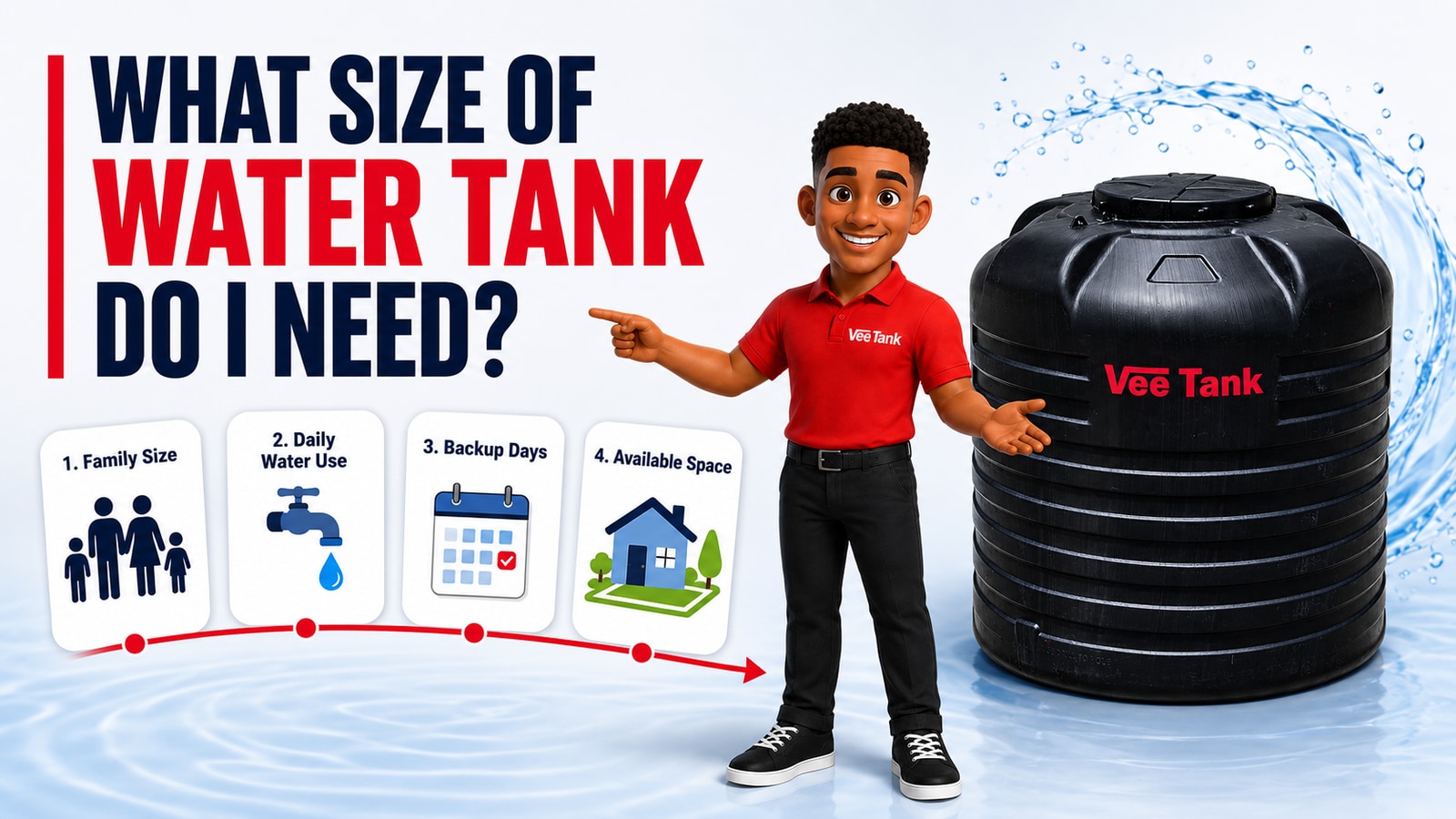
In short: multiply the number of people by the litres each uses in a day, then multiply by the number of days you want to hold. A family of five in a modern home, holding three days, needs about 1,500 litres — so a 1,500 L tank covers it and a 2,300 L tank gives you room to breathe.
Most people pick a tank the other way round. They choose a size that sounds about right, and find out in the dry season whether it was. The arithmetic takes two minutes and it is worth doing properly, because the tank you buy is the tank you live with for years.
The formula
People × litres per person per day × days of reserve = the size you need.
Three numbers. Take them one at a time.
Step 1: how much does one person use a day?
For a modern home with indoor plumbing, flush toilets and a shower, plan on about 100 litres per person per day. That is the figure the Vee Tank Sizer uses, and it is a planning number rather than a measurement — it covers drinking, cooking, washing, laundry and sanitation with a little slack in it.
Use less if your household is genuinely frugal or draws water only for the essentials. Use more if you have a washing machine running most days, a garden that needs watering, or long showers.
Step 2: how many days do you want to hold?
This is the part people skip, and it is the part that decides whether the tank does its job.
Three days is a sensible default for a home on a municipal supply that is reliable but not guaranteed. It carries you through a weekend outage without anyone rationing.
Push it to five or seven days if your supply is unpredictable, if you are on a borehole with a pump that depends on grid power, or if you are far enough out that a water bowser is a half-day errand rather than a phone call.
Step 3: multiply
| Household | Litres a day (at 100 L each) | Three days | Sensible tank |
|---|---|---|---|
| 2 people | 200 L | 600 L | 1,000 L |
| 3 people | 300 L | 900 L | 1,000 L |
| 4 people | 400 L | 1,200 L | 1,500 L |
| 5 people | 500 L | 1,500 L | 1,500 – 2,300 L |
| 6 people | 600 L | 1,800 L | 2,300 L |
| 8 people | 800 L | 2,400 L | 3,000 L |
| 10 people | 1,000 L | 3,000 L | 3,000 – 5,000 L |
The right-hand column rounds up, never down. A tank that is slightly too big costs a little more once. A tank that is slightly too small costs you every dry week for the next decade.
Why round up
Three reasons, and they compound.
Households grow. Children, relatives staying, a house help moving in. The tank does not grow with them.
A tank is rarely full to the brim. Between the inlet and the overflow you lose a little headroom, and most people do not refill from bone dry.
The price gap is smaller than the size gap. Stepping from 1,500 L to 2,300 L adds about half as much water again; it does not add half as much cost again. Capacity is the cheapest thing you will ever buy for a water system — pipework, pumps and fittings all cost more per litre delivered.
What about rainwater?
If you are harvesting off a roof, size the tank against what the roof actually collects rather than against what the family drinks.
The rough figure is roof area in square metres × rainfall in millimetres × 0.8, which gives litres. The 0.8 is a collection efficiency — some rain evaporates off a hot roof, some overshoots the gutter, some is lost to the first flush.
A 100 m² roof in a month with 120 mm of rain collects roughly 9,600 litres. Storing all of it needs a 10,000 L tank. Storing a useful part of it needs far less. The Vee Tank Sizer will do this from your location's rainfall figures if you would rather not.
The Vee Tank range
Six sizes: 1,000, 1,500, 2,300, 3,000, 5,000 and 10,000 litres. If you need more than 10,000 litres, tanks can be plumbed together — tell us the demand and we will plan it with you.
Every one of them is blow moulded with a three-layer wall and carries a 12-year warranty from Astral Industries Limited.
Two things that are not about capacity
Where it will stand. A full 2,300 L tank weighs about 2.3 tonnes. It needs a level, load-bearing base — a proper slab or a stand rated for it — and it needs to be high enough to feed the house on gravity if you are not pumping. Measure the space before you buy the size.
How it will fill and empty. Check the inlet reaches, the overflow discharges somewhere sensible, and the outlet is where your plumbing wants it. A well-sized tank in the wrong place is still the wrong tank.
Still not sure?
Use the Tank Sizer — tell it who is using the water and what for, and it works the capacity out. Or send us your details and we will size it with you.